
What Is Warehouse Automation? A Complete Guide for South African Businesses
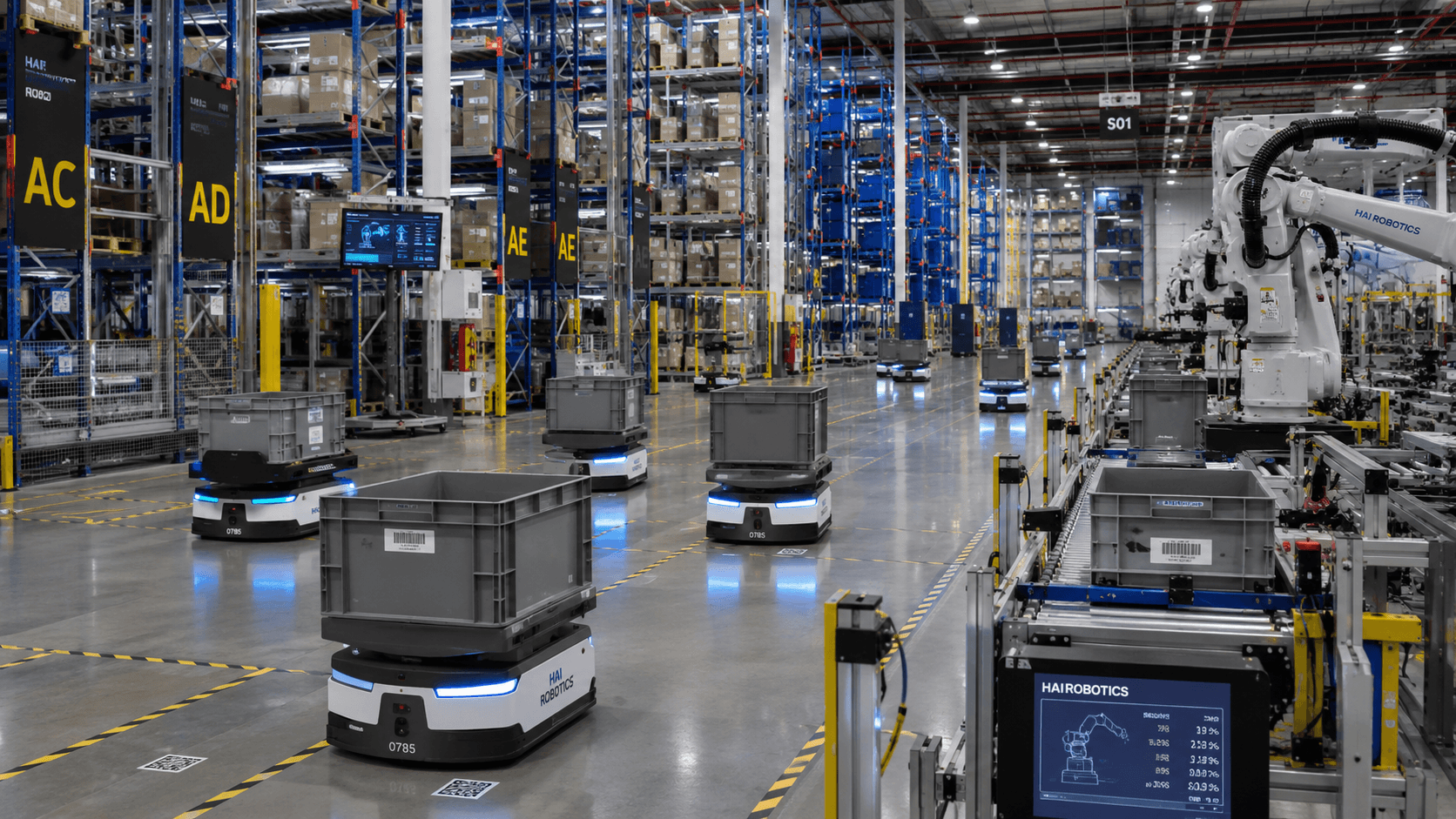
What Is Warehouse Automation?
Warehouse automation is the use of technology — robots, conveyors, sortation systems, and intelligent software — to perform material handling and fulfilment tasks with reduced or no manual intervention.
For South African businesses, this is not a distant concept or something reserved for multinational corporations. Operations across the country — from mid-sized e-commerce fulfiment centres in Johannesburg to pharmaceutical distributors in Cape Town — are adopting automation to stay competitive, manage rising labour costs, and meet growing customer expectations for speed and accuracy.
This guide explains what warehouse automation actually involves, how the key technologies work, and how to evaluate whether it's the right time to start.
---
The Core Problem Automation Solves
A traditional warehouse relies on people to move goods: walking to pick locations, carrying products to packing stations, sorting cartons into dispatch lanes. These tasks are repetitive, physically demanding, and prone to human error.
The cost structure of a manual warehouse is dominated by labour. In South Africa, wage inflation has consistently outpaced general inflation over the last decade. Add in skills shortages, high turnover in the warehouse sector, and the difficulty of scaling headcount for seasonal peaks — and the case for automation becomes increasingly compelling.
Automation addresses these challenges by replacing the repetitive physical movement tasks with consistent, programmable systems that operate 24 hours a day, do not take breaks, and produce measurable and predictable output.
---
The Key Technologies in Warehouse Automation
AMRs and AGVs
Autonomous Mobile Robots (AMRs) and Automated Guided Vehicles (AGVs) are the mobile workhorses of a modern automated warehouse.AMRs use onboard sensors and SLAM (Simultaneous Localisation and Mapping) technology to navigate dynamically — building a map of their environment and routing around obstacles. They're commonly used for goods-to-person picking, where they bring inventory shelves or totes to stationary pick stations.
AGVs follow fixed navigation paths — magnetic tape, wire, or laser reflectors — and are better suited to high-volume, repetitive transport tasks on consistent routes.
Both technologies eliminate picker travel, which accounts for 60–70% of a manual picker's shift. The result is a dramatic increase in pick rates and a significant reduction in labour cost per unit. For a more detailed comparison, see our guide on AGV vs AMR: which robot is right for your warehouse.
Automated Conveying Systems
Conveyors form the transport network of an automated warehouse — connecting receiving, storage, pick stations, packing, and dispatch into a continuous flow. Modern conveying systems use motorised rollers (MDR) that power zones independently, allowing zero-pressure accumulation where items queue without touching.Automated Sorting Systems
Sortation systems — cross-belt sorters, tilt-tray sorters, and shoe sorters — route individual cartons, parcels, or polybags to specific destination chutes at high speed and accuracy. A modern cross-belt sorter can process 8,000–15,000 items per hour with sort accuracy exceeding 99.9%.Warehouse Management Software
The software layer — WMS, WES, and WCS — is as important as the physical hardware. The WMS manages inventory and orders. The WES coordinates task execution across automated and manual resources in real time. The WCS controls the physical hardware. Integration between these layers and your existing ERP or e-commerce platform is what makes the automation work as a coherent system.
---
Why Warehouse Automation Matters in South Africa Specifically
South African warehouse operations face a specific set of challenges that make automation particularly relevant:
Rising labour costs — South African warehouse wages have increased substantially, while productivity benchmarks in manual operations have remained largely flat. The gap between labour cost and automated cost per unit is widening. Load shedding resilience — Contrary to what you might expect, well-designed automation can be more resilient than manual operations during load shedding. AMRs and AGVs operate on batteries that continue through short outages. UPS systems protect control infrastructure. Automated operations can be resumed within minutes of power restoration — manual operations require staff recall and re-orientation. Skills availability — Finding and retaining trained warehouse supervisors and pickers is increasingly difficult. Automation reduces reliance on skilled manual labour for repetitive tasks while creating more technically engaging roles that are easier to retain. E-commerce growth — South Africa's e-commerce sector is growing rapidly, driving demand for faster fulfilment and higher accuracy that manual operations struggle to meet consistently.---
What Does Warehouse Automation Cost?
Cost varies enormously based on the scope and type of automation. As a guide:
- A small AMR fleet (10–20 robots) for a growing e-commerce operation typically costs R3–R8 million installed, with payback in 2–4 years.
- A motorised roller conveying system connecting pick and pack in a mid-size DC typically costs R1.5–R5 million, with payback in 18–36 months.
- A full-scale cross-belt sorter for a large distribution centre may cost R8–R25 million, with payback in 3–5 years.
---
Where to Start
The most common mistake in warehouse automation is trying to automate everything at once. The most effective approach is to:
Allied Automation offers a free initial assessment for South African businesses. Our senior automation specialists will visit your facility and provide a written assessment with clear findings and recommendations — no obligation to proceed.
---
The Bottom Line
Warehouse automation is not an all-or-nothing decision, and it's no longer out of reach for South African businesses outside the top tier of national retailers and logistics companies. The technology is modular, scalable, and increasingly proven in the local operating environment.
The question is not whether to automate — it's where to start and how to build the business case. That's a conversation Allied Automation has with operations like yours every week.
Ready to explore what automation could do for your operation? Book a free site assessment with our South African team today.
Senior Automation Specialist — Africa
Shaun leads Allied Automation's African operations, specialising in warehouse automation solutions across South Africa and the broader African continent. He focuses on AMR fleet deployments, sortation system design, and WMS integration for distribution environments.
Ready to Automate Your Warehouse?
Book a free assessment with our South African team and find out what automation can deliver for your operation.