
Warehouse Automation Glossary
Plain-English definitions for every term you'll encounter when evaluating, specifying, or implementing warehouse automation — from AGV to zone picking.
Quick Answer
What is warehouse automation?
Warehouse automation is the use of technology — robots, conveyors, sortation systems, and intelligent software — to perform material handling and fulfilment tasks with reduced or no manual intervention. Systems range from simple conveyor lines to fully autonomous robot fleets and high-density automated storage solutions.
A
- AGV (Automated Guided Vehicle)
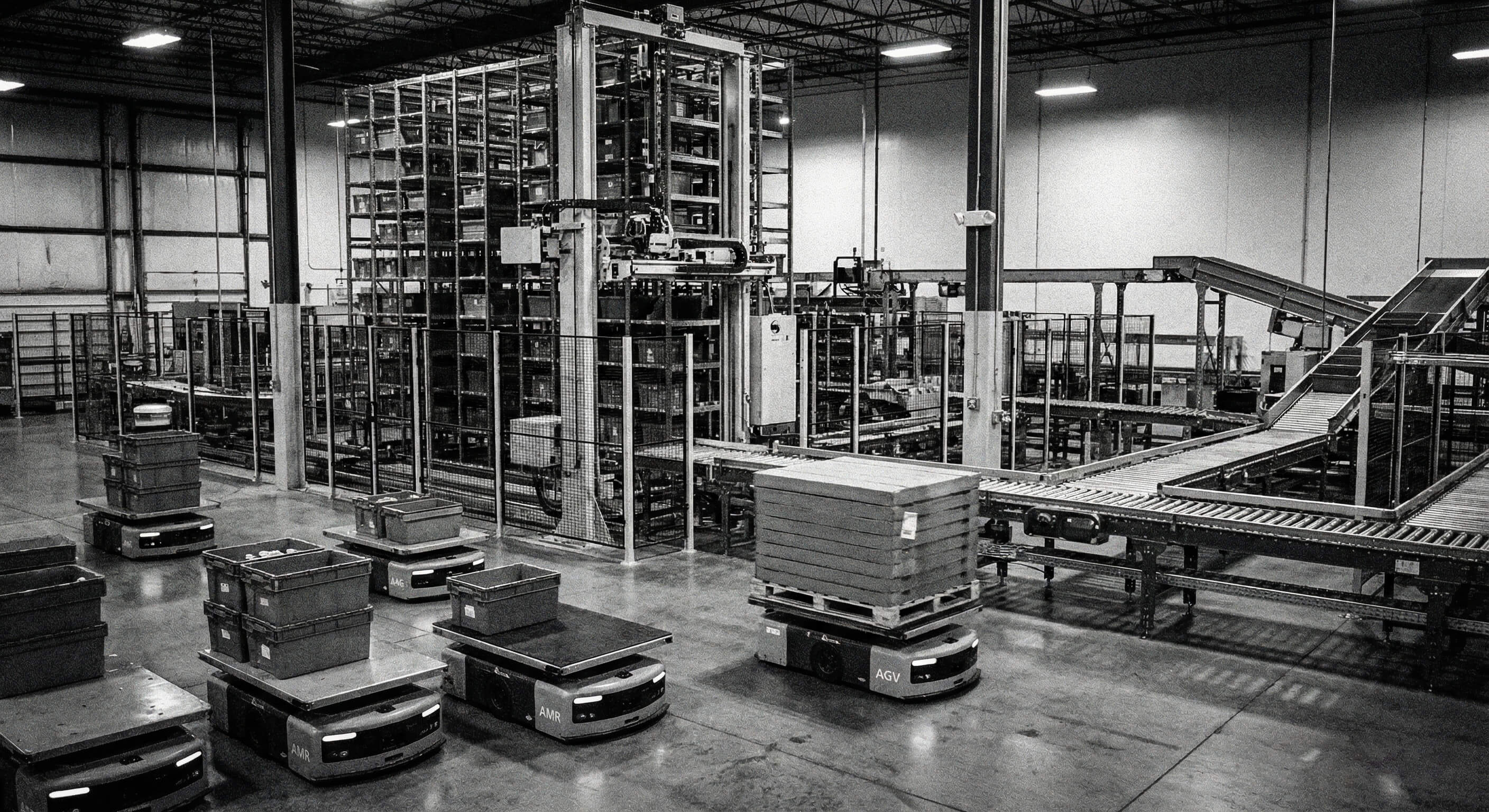
- An Automated Guided Vehicle (AGV) is a mobile robot that follows a fixed navigation path — typically defined by magnetic tape, wire, optical markers, or laser reflectors — to transport materials within a warehouse or manufacturing facility. AGVs are best suited to repetitive, high-volume transport tasks on consistent routes where the environment does not change frequently.
- AMR (Autonomous Mobile Robot)
- An Autonomous Mobile Robot (AMR) uses onboard sensors, cameras, and SLAM navigation to map its environment and navigate dynamically — without fixed paths or physical infrastructure changes. AMRs can route around obstacles, adapt to changing floor layouts, and work collaboratively with people. They are widely used for goods-to-person picking, material transport, and inventory management tasks.
- AS/RS (Automated Storage and Retrieval System)
- An Automated Storage and Retrieval System (AS/RS) uses automated cranes, shuttles, or mini-load systems to store and retrieve goods from high-density racking without human intervention. AS/RS systems maximise storage density, provide precise inventory location, and enable very fast retrieval for high-velocity SKUs. Common types include unit-load cranes, mini-load systems, and carton shuttle systems.
- Autonomous Forklift
- An autonomous forklift is a self-navigating forklift truck that transports and stacks pallets without a human operator. Using laser, vision, or hybrid navigation, autonomous forklifts operate 24 hours a day, handle payloads of 1,000–5,000 kg, and can reach heights of up to 12 metres in high-bay configurations. They comply with ISO 3691-4 safety standards for driverless industrial trucks.
B
- Barcode Scanning
- Barcode scanning in warehouse automation refers to the automated identification of items using laser or camera-based readers that decode 1D (linear) or 2D (matrix) barcodes. In sortation and conveying systems, scan tunnels with multiple readers on all sides identify items at induction points, triggering routing decisions. Read rates of 99.5%+ are achievable with good label quality and 6-side scan coverage.
- Batch Picking
- Batch picking is an order picking method where a single picker collects items for multiple orders simultaneously in one warehouse tour. Picked items are subsequently sorted to individual orders at a sort station or put wall. Batch picking increases picker productivity per tour but requires a secondary sorting step. It is most effective in operations with many small, similar orders — such as e-commerce fulfilment.
C
- Collaborative Robot (Cobot)
- A collaborative robot (cobot) is designed to operate safely alongside humans without physical guarding, using force-sensing, speed monitoring, and proximity detection to prevent injury. In warehouse applications, cobots are used for pick-and-place, palletising, and packaging tasks at shared workstations. They complement human workers rather than replacing them entirely, handling ergonomically challenging or repetitive movements.
- Conveyor
- A conveyor is a mechanical system that continuously transports goods between locations in a warehouse or facility without manual carrying. Types include flat belt conveyors, modular belt conveyors, roller conveyors, and overhead systems. Conveyors form the transport backbone of distribution centres, connecting receiving, storage, picking, packing, and despatch zones into a continuous product flow.
- Cross-Docking
- Cross-docking is a logistics practice where inbound goods are transferred directly to outbound transport with minimal or no storage time. Products arrive at the receiving dock, are sorted and consolidated for outbound routes, and are dispatched without entering long-term storage. Automated conveying and sortation systems make cross-docking operations significantly faster and more accurate than manual equivalents.
- Cycle Time
- Cycle time is the total time required to complete one full process cycle — in warehouse contexts, this typically means the time from order receipt to order despatch, or the time to complete one pick-and-pack operation. Reducing cycle time is a primary driver of warehouse automation: AMRs and conveying systems dramatically reduce the travel and handling time components of the overall cycle.
D
- Dark Warehouse
- A dark warehouse (also called a lights-out warehouse) is a fully automated facility that operates without human workers on the warehouse floor — and therefore without the need for lighting, heating, or other human-comfort infrastructure. Dark warehouse operations use robots, autonomous vehicles, and automated storage systems exclusively. Most facilities operate as "grey" warehouses — partially automated with human workers in specific roles.
- Depalletiser
- A depalletiser is a machine or robotic system that automatically removes layers of products from a pallet and places them onto a conveyor or into a storage system. Depalletisers are used at inbound receiving to automate the breakdown of supplier pallets, eliminating manual layer-picking. They are available in both conventional (layer-by-layer) and robotic (individual case) configurations.
- Distribution Centre
- A distribution centre (DC) is a warehouse facility dedicated to receiving, sorting, storing, and dispatching goods to retail stores, e-commerce customers, or other distribution points. Unlike manufacturing warehouses, DCs focus on throughput — moving goods through quickly rather than storing them long-term. Automation in distribution centres targets the pick, sort, and despatch functions that account for the majority of labour cost.
E
- End Effector
- An end effector is the tool at the end of a robotic arm that interacts with the product — gripping, lifting, placing, or manipulating it. Common end effectors in warehouse and logistics automation include vacuum suction grippers (for boxes, bags, and flat items), mechanical grippers (for irregular shapes), and magnetic grippers (for metal components). The end effector is selected based on the product type and handling requirement.
F
- FEFO (First Expiry, First Out)
- FEFO (First Expiry, First Out) is a stock rotation principle requiring that the batch with the earliest expiry date is picked and dispatched before later-expiring stock. FEFO is mandatory in pharmaceutical, food, and medical distribution. Automated WMS systems enforce FEFO consistently and without exception — unlike manual picking, where FEFO relies on operator awareness and discipline at every transaction.
- FIFO (First In, First Out)
- FIFO (First In, First Out) is a stock rotation principle requiring that goods received first are dispatched first. FIFO prevents older stock from being pushed to the back of storage locations by newer deliveries. In perishables, FIFO and FEFO often align. WMS-directed automation enforces FIFO without operator discretion, ensuring consistent stock rotation across all SKUs and storage locations.
- Fleet Management System
- A fleet management system (FMS) is the software layer that coordinates and optimises the tasks, routing, charging, and real-time status of a fleet of AGVs, AMRs, or autonomous forklifts. The FMS receives transport tasks from the WMS or MES, assigns them to available vehicles, monitors robot status and battery levels, manages charging schedules, and provides KPI dashboards for supervisors and managers.
- Fulfilment Centre
- A fulfilment centre is a type of warehouse specifically optimised for processing individual e-commerce orders — receiving goods, storing them, picking individual items per customer order, packing them, and dispatching them to the customer. The fulfilment centre is distinguished from a distribution centre by its focus on single-unit order processing rather than bulk pallet movements. It is the primary application environment for AMRs and goods-to-person automation.
- 4PL (Fourth-Party Logistics)
- A Fourth-Party Logistics provider (4PL) manages the entire supply chain on behalf of a client — including overseeing 3PLs, carriers, customs brokers, and other logistics partners. 4PLs are less involved in physical warehouse operations than 3PLs but increasingly require visibility into automated warehouse systems to provide real-time supply chain intelligence. Allied Automation's WMS and fleet management systems provide data feeds suitable for 4PL visibility platforms.
G
- Goods-to-Person
- Goods-to-person (GTP) is an automation approach where robots or automated systems bring the required inventory to a stationary pick station, rather than requiring a picker to travel to the storage location. GTP eliminates walk time — which typically accounts for 60–70% of a manual picker's shift — and dramatically increases pick rates. Common GTP technologies include AMR pod systems, mini-load AS/RS, and horizontal carousels.
I
- Intralogistics
- Intralogistics refers to all internal logistics processes within a single facility — the flow of materials, goods, and information from goods receipt through storage, picking, packing, and dispatch. It encompasses physical material handling (conveyors, forklifts, robots) and the software that coordinates it (WMS, WES, WCS, FMS). Optimising intralogistics is the primary goal of warehouse and manufacturing automation.
L
- LIFO (Last In, First Out)
- LIFO (Last In, First Out) is a stock management principle where the most recently received goods are the first to be dispatched. LIFO is primarily used in non-perishable goods contexts where expiry is not a concern — for example, bulk commodity storage where the most accessible (top or front) stock is dispatched first. It is rarely used in automated warehouses with WMS management, where FIFO or FEFO rotation is typically enforced.
M
- MES (Manufacturing Execution System)
- A Manufacturing Execution System (MES) manages and monitors production processes in real time, tracking work-in-progress, production orders, and material consumption on the factory floor. In intralogistics automation, the MES is the trigger system for AGV/AMR line replenishment tasks — when the production line consumes a component, the MES generates a replenishment request that the automation system fulfils automatically.
- Mini Sorter
- A mini sorter is a compact, high-accuracy sortation system designed for small parcels, polybags, and individual items. Mini sorters achieve the throughput and accuracy of large-scale sorters in a significantly smaller footprint, making them suitable for mezzanine installations and facilities where floor space is limited. They handle items from 50 g to 5 kg and achieve sort rates of 2,000–10,000 items per hour.
- Motorised Roller
- A motorised roller (MDR — Motorised Drive Roller) is a conveyor roller with a brushless DC motor built into its body. MDR conveyors power each zone independently, enabling zero-pressure accumulation (items queue without touching), zone-by-zone control, and significant energy savings compared to line-shaft conveyors — rollers only run when product is present. MDR conveyors are the modern standard for energy-efficient carton and tote transport.
O
- OEE (Overall Equipment Effectiveness)
- Overall Equipment Effectiveness (OEE) is a manufacturing KPI that measures the percentage of planned production time that is truly productive — combining availability (uptime), performance (speed vs target), and quality (good units vs total). In intralogistics, automation directly improves OEE by eliminating material supply failures (availability), ensuring consistent takt-matched delivery (performance), and reducing part errors (quality).
- Order Management System
- An Order Management System (OMS) manages the end-to-end lifecycle of customer orders — from order receipt through inventory allocation, fulfilment routing, warehouse instructions, and delivery confirmation. In automated warehouses, the OMS passes orders to the WMS, which directs automation systems to fulfil them. OMS integration is essential for e-commerce operations routing orders across multiple fulfilment channels.
P
- Palletiser
- A palletiser is a machine or robotic system that automatically stacks individual cases, bags, or units onto a pallet in a defined pattern. Palletisers are used at the end of manufacturing lines, in distribution centres, and at despatch staging areas. Robotic palletisers with vision systems can handle mixed-SKU pallets with varying case sizes — a task that conventional layer palletisers cannot perform.
- Person-to-Goods
- Person-to-goods (PTG) is the traditional warehouse picking model where a human picker travels through the warehouse to the storage location of each required item. PTG is labour-intensive — pickers typically travel 10–15 km per shift — and is increasingly replaced or supplemented by goods-to-person (GTP) automation in high-throughput operations. PTG picking suits low-volume, high-mix operations where automation ROI is not yet justified.
- Pick Rate
- Pick rate is a warehouse productivity metric measuring the number of order lines or units picked per operator per hour. Manual pick rates in walk-and-pick operations typically range from 80–150 lines per hour, depending on warehouse size and travel distances. Goods-to-person AMR systems raise this to 300–600 lines per hour by eliminating travel time. Pick rate is a primary KPI for measuring the benefit of warehouse automation.
- Pick-and-Place
- Pick-and-place in automation refers to a robotic process that picks an item from one location and places it precisely in another — on a conveyor, in a tote, into packaging, or onto a pallet. Pick-and-place robots use vacuum, mechanical, or magnetic end effectors and are guided by vision systems for accurate item identification. They are used in manufacturing assembly, packaging lines, and order fulfilment.
- Put Wall
- A put wall is an order consolidation system — a matrix of cubbies or shelves where batch-picked items are sorted into individual customer orders. Workers (or robots) place items into the correct cubby, guided by lights or a screen display. When all items for an order are present, the cubby is cleared for packing. Put walls bridge the gap between batch picking efficiency and individual order accuracy.
R
- RFID (Radio Frequency Identification)
- RFID (Radio Frequency Identification) is a wireless identification technology using radio waves to read data from tags attached to items, pallets, or containers — without requiring line-of-sight or individual scanning. RFID enables bulk reading of multiple items simultaneously, making it faster than barcode scanning for inbound receipts and cycle counting. UHF RFID is increasingly used in apparel, pharmaceuticals, and high-value goods tracking.
- Robotic Process Automation (RPA)
- In the warehouse context, Robotic Process Automation (RPA) typically refers to software automation of repetitive digital tasks — data entry, report generation, order processing reconciliation — rather than physical robotics. Physical warehouse automation (AMRs, conveyors, sorters) is distinct from RPA. RPA is relevant where warehouse management involves high-volume manual data processing that can be automated without modifying the underlying IT systems.
- Returns Processing
- Returns processing (also called reverse logistics) is the warehouse workflow for receiving, grading, dispositioning, and restocking returned customer orders. Automation accelerates returns processing through structured grading workstations, barcode identification, automated conveying to disposition zones, and WMS-driven restock confirmation. Fast, accurate returns processing reduces the time between a return arriving and the product being available for resale.
S
- SKU (Stock Keeping Unit)
- A SKU (Stock Keeping Unit) is a unique identifier assigned to each distinct product variant in a warehouse — distinguishing products by size, colour, pack size, and other attributes. SKU count is a key factor in warehouse automation design: operations with thousands of SKUs benefit differently from automation than those with a small number of high-volume lines. High-SKU environments are strong candidates for goods-to-person AMR systems.
- Sortation
- Sortation is the automated process of routing individual items, cartons, or parcels to specific destination chutes, lanes, or positions based on their identity. Sortation systems use barcode scanning or RFID to identify items and then divert them using cross-belts, tilt trays, push sorters, or pop-up wheels. Sortation is a critical function in parcel delivery, retail distribution, and airport baggage handling operations.
T
- Takt Time
- Takt time is the maximum time allowed to produce one unit to meet customer demand — calculated by dividing available production time by customer demand rate. In manufacturing intralogistics, takt time defines how frequently material must be delivered to each production station. AGV and AMR replenishment systems must be designed to deliver materials within the takt window without buffer stock accumulation or line-side shortfalls.
- Throughput
- Throughput is the rate at which a warehouse or system processes goods — typically measured in orders per hour, cartons per hour, or picks per hour. Maximising throughput is a primary objective of warehouse automation design. System throughput is constrained by the slowest element in the operational chain — a principle that drives Allied Automation's whole-system design approach, ensuring no single process step becomes a bottleneck.
- 3PL (Third-Party Logistics)
- A Third-Party Logistics provider (3PL) is a company that provides outsourced warehousing, fulfilment, and distribution services to other businesses. 3PLs face unique automation challenges: they serve multiple clients with different product types, WMS requirements, and SLAs in a shared facility. Allied Automation designs multi-client automation systems for 3PL environments, including dynamic sort destination assignment and client-isolated inventory management.
U
- Unit Load
- A unit load is a single, discrete load handled as one unit in a warehouse — typically a pallet, a tote, a carton, or a roll cage. Unit load design is a fundamental warehouse engineering decision that affects storage density, handling method, automation compatibility, and transport efficiency. Autonomous forklifts and AGV systems are designed around specific unit load types and dimensions.
V
- Vision System
- A vision system uses cameras and image processing software to identify, inspect, or guide the handling of items in an automated warehouse. Applications include barcode and label reading in scan tunnels, dimensional measurement (cubing) of parcels, cosmetic grading of returned goods, palletising pattern recognition for robotic palletisers, and pick guidance for robotic picking arms. Vision systems enable automation to handle product variety that would otherwise require human judgement.
W
- Wave Picking
- Wave picking is an order fulfilment strategy where orders are grouped and released to the warehouse floor in scheduled waves — typically timed to align with carrier collection windows or shift changes. Each wave contains a defined set of orders that pickers work simultaneously. Wave management software (within the WMS or WES) optimises wave composition to balance workload, minimise travel, and meet despatch deadlines.
- WES (Warehouse Execution System)
- A Warehouse Execution System (WES) sits between a WMS (which manages inventory and orders) and a WCS (which controls automation hardware), coordinating real-time task execution across both manual operators and automated systems. A WES optimises work allocation dynamically — routing tasks to the fastest available resource (human or robot) and adjusting in real time as conditions change. Modern automation platforms increasingly combine WES and WCS functionality.
- WMS (Warehouse Management System)
- A Warehouse Management System (WMS) is the software foundation of a warehouse operation, managing inventory location, order processing, receiving, putaway, picking, packing, and dispatch. In automated warehouses, the WMS is the source of truth for inventory and orders — directing automation systems (via WES/WCS) on what to move and where. WMS integration is a core component of every Allied Automation project.
Z
- Zone Picking
- Zone picking divides a warehouse into geographic zones, with dedicated pickers assigned to each zone. Each picker fulfils only the order lines located in their zone, and totes or order containers travel between zones on a conveyor until the order is complete. Zone picking reduces picker travel and specialises staff in their section, improving both speed and accuracy. It is commonly used in conjunction with conveying automation.
Ready to Put These Concepts to Work?
Book a free assessment with our South African team and we'll show you which systems are right for your operation.