
AGV vs AMR: Which Robot Is Right for Your Warehouse?
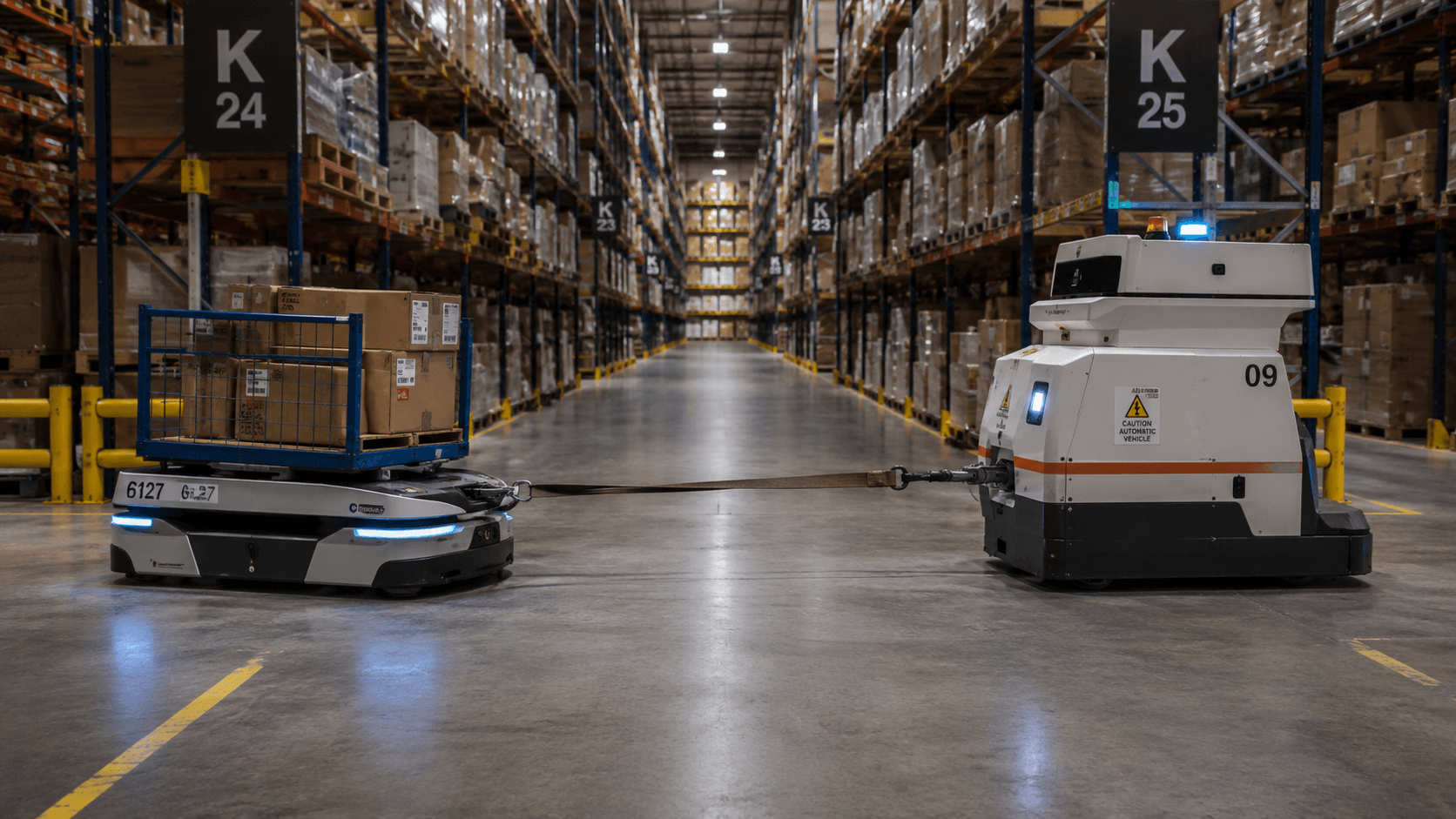
AGV vs AMR: Understanding the Difference
When businesses start exploring warehouse automation, one of the first questions is almost always: "Should we use AGVs or AMRs?"
Both are autonomous vehicles that move materials without a human driver. Both can dramatically reduce labour costs and increase throughput. But they work on fundamentally different principles — and understanding that difference will determine which is right for your operation.
---
How AGVs Work
An Automated Guided Vehicle (AGV) follows a predefined navigation path. The most common guidance technologies are:
- Magnetic tape — a strip of magnetic tape on the floor defines the route; the AGV follows it using an onboard magnetic sensor
- Wire guidance — a wire embedded in the floor emits a signal the AGV tracks
- Laser reflectors — reflective targets are mounted on walls and racking; the AGV navigates by triangulating its position relative to these targets
- Optical markers — coloured tape or printed markers on the floor
Where AGVs Excel
AGVs are ideal for:
- High-volume, repetitive transport routes — moving pallets from receiving to storage on a fixed corridor, for example
- Environments where the layout is stable — the route infrastructure doesn't move, so the fixed-path limitation isn't a constraint
- Heavy payload applications — AGV truck systems routinely handle 1,000–5,000 kg and can lift to 12 metres in high-bay configurations
- Cold store and hazardous environments — where human access is undesirable and the environment doesn't change
How AMRs Work
An Autonomous Mobile Robot (AMR) uses onboard sensors — typically lidar, cameras, and depth sensors — and SLAM (Simultaneous Localisation and Mapping) technology to navigate dynamically.
SLAM means the robot builds a map of its environment while simultaneously tracking its own position within that map. Rather than following a fixed route, the AMR calculates its path in real time, routing around obstacles and adapting to changes in the facility layout.
No floor tape. No reflectors. No route infrastructure.
Where AMRs Excel
AMRs are ideal for:
- Goods-to-person picking — the most impactful use case; AMRs carry inventory shelves (pods) to stationary pick stations, eliminating picker travel entirely
- Flexible environments — layouts that change frequently, facilities shared with manual operations, or operations where floor space is used for multiple purposes
- Collaborative operation — AMRs are designed to navigate around people; many models are certified for fully mixed-operation environments
- Rapid deployment — no floor modifications required; AMRs can be operational within days of arrival
The Key Differences at a Glance
| Factor | AGV | AMR |
|---|---|---|
| Navigation | Fixed path (tape, wire, laser) | Dynamic (SLAM) |
| Infrastructure changes | Requires floor/wall modifications | None required |
| Obstacle response | Stops and waits | Routes around obstacles |
| Flexibility | Low | High |
| Payload range | 50 kg – 5,000 kg+ | 50 kg – 1,500 kg (typical) |
| Typical applications | Pallet transport, high-bay, cold store | Goods-to-person, tote transport, flexible routing |
| Deployment time | 8–16 weeks | 4–12 weeks |
| Best fit | Stable, high-volume routes | Flexible, mixed-traffic environments |
---
Which Is Right for Your Warehouse?
The answer depends on what you're trying to achieve:
Choose AGVs if:- You need to move heavy pallets (1,000 kg+) on consistent routes
- Your facility layout is stable and unlikely to change
- You're operating in a cold store, freezer, or hazardous environment
- You want the maximum reliability for a specific, defined transport task
- Your priority is picking productivity — goods-to-person is your target
- Your facility layout changes regularly or you share space with manual operations
- You need to deploy quickly with minimal disruption
- Your payloads are carton or tote-level (up to ~500 kg)
- Your warehouse has distinct zones: a high-bay storage area (AGVs for pallet movement) and a picking area (AMRs for goods-to-person)
- Your operation is growing and you want to start with AMRs for picking and add AGV forklift automation later
A Note on Hybrid Fleets
Many modern automated warehouses use both AGVs and AMRs. A common configuration:
- Autonomous forklift AGVs handle inbound palletised goods from the receiving dock to bulk storage racking — heavy, consistent, fixed-route work
- AMR pods carry inventory totes from storage to pick stations in the goods-to-person picking zone — flexible, high-variety, collaborative work
- Conveying systems connect the two, transporting picked items from pick stations to packing and dispatch
---
Making the Decision
The right choice depends on your specific operation — payload requirements, facility layout, throughput targets, growth plans, and budget. This isn't a decision that should be made from a spec sheet comparison alone. If you're working through the financial case, our article on the true cost of manual picking shows how to model the full ROI for either technology.
Allied Automation's site assessment process is designed to answer exactly this question for your facility. Our automation specialists will review your operational data, analyse your facility layout, model both AGV and AMR options, and present a recommendation with a clear financial model.
The assessment is free, and there's no obligation to proceed. Contact our South African team to book yours.
Senior Automation Specialist — Africa
Shaun leads Allied Automation's African operations, specialising in warehouse automation solutions across South Africa and the broader African continent. He focuses on AMR fleet deployments, sortation system design, and WMS integration for distribution environments.
Ready to Automate Your Warehouse?
Book a free assessment with our South African team and find out what automation can deliver for your operation.